
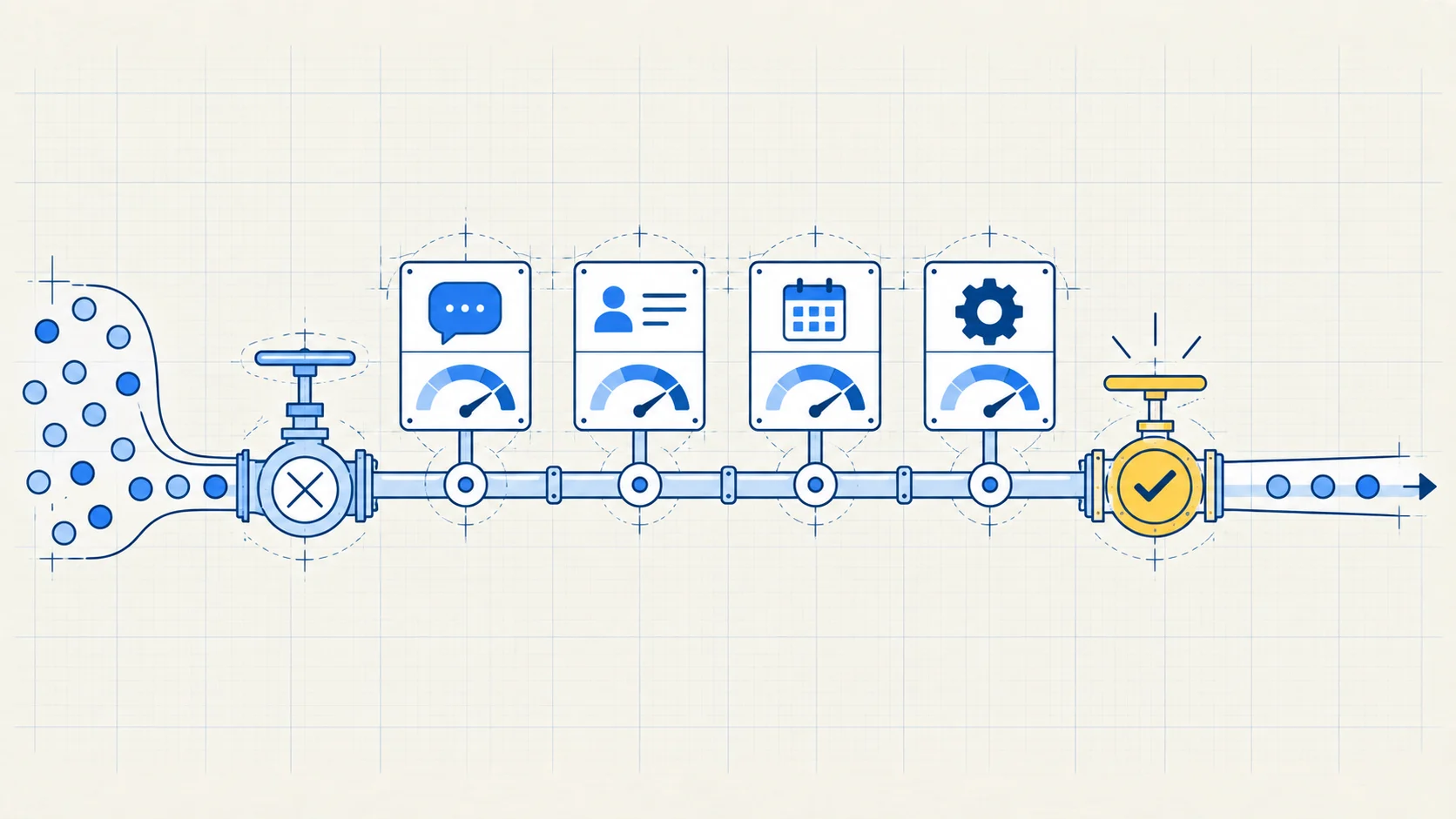
More leads will not fix a process that already loses enquiries or delays customers. Before you add more leads, check whether your team can handle the extra work.
You have three choices:
- Pause if an important step is failing now.
- Prepare if the process works but needs more capacity.
- Proceed if every step has an owner and the team has time.
Check the full path
Write down what happens from the first enquiry to delivery:
- The enquiry arrives.
- Someone receives an alert.
- A person replies.
- The lead is checked for fit.
- The lead books the next step.
- The customer starts receiving the service.
Find the first step that is slow, unclear or easy to miss. Adding more leads will put more pressure on that step.
If delivery is already late, the problem comes after the sale. If leads sit in different inboxes, the problem is follow-up. If the process works well but few people enquire, you may be ready to test more lead generation.
Follow one recent enquiry
Choose one real enquiry and answer these questions:
- Where did it arrive?
- Who saw it?
- Who replied?
- Where was the lead's status recorded?
- How did the person book?
- Who followed up if they did not book?
- If they bought, who started the work?
You do not need a perfect process. You need clear owners and a record that your team can follow.
Estimate the extra work
Use your own numbers before increasing lead volume.
Here is a hypothetical example. It is not a forecast or promise.
Suppose you expect 20 more enquiries each week:
- Replying to 20 enquiries at 15 minutes each takes 5 hours.
- Eight qualification calls at 30 minutes each take 4 hours.
- Setting up three new customers at 2 hours each takes 6 hours.
- Total extra work in the first week: 15 hours.
This does not include rescheduling, proposals, internal messages or ongoing delivery. Replace these assumptions with your real numbers.
If nobody knows where the extra hours will come from, prepare the team before adding more leads.
Pause, prepare or proceed
| Area | Pause | Prepare | Proceed |
|---|---|---|---|
| Enquiries | Some can be missed | One clear record is being set up | Every enquiry has a visible status |
| Ownership | Nobody clearly owns the reply | An owner needs backup or instructions | An owner and backup are ready |
| Follow-up | Unbooked leads disappear | Follow-up steps are being written | Every lead gets a clear next step |
| Qualification | The team cannot explain a good fit | The rules are used inconsistently | The rules guide the next action |
| Delivery | Current work is already late | More capacity is being arranged | The team can take on the extra work |
One serious problem may be enough to pause. For example, free delivery capacity does not help if nobody replies to enquiries.
What to do next
Pause if more leads would enter a broken process. Fix the first weak step.
Prepare if one clear change will make the process ready. Name the change, its owner and the date it should be finished.
Proceed if the path is clear, the extra work has an owner and your numbers are realistic. Start with a small test and review what happened before adding more volume.
I have spent thousands of hours learning marketing. Scale Manual turns that work into practical steps you can use to build a lead system you understand and control.